Anxiety has become one of the most common concerns encountered by pastors, professional church workers, and counselors. As mental health discussions become more common within society, local congregations have a unique opportunity to be a part of those discussions by offering spiritual care and meaningful support to those who struggle with anxiety.
Many professional church workers feel inadequately prepared to address anxiety. Part of the problem is that pastoral formation typically focuses on theology and ministry practice and not psychology and therapy. Pastoral formation gives limited attention to contemporary mental health research.
Anxiety is more than a psychological condition. There is a spiritual element to it as well. And so, anxiety is more than a clinical concern; it is a pastoral concern as well. Pastors need to be able to balance a biblical understanding of anxiety with a psychological understanding. While these approaches focus on different aspects of human experience, they are not mutually exclusive. A biblical understanding of anxiety focuses on trust and dependence on God, whereas a psychological understanding focuses on cognitive, emotional, and physiological frameworks. Scripture frequently addresses anxiety through the themes of trust in God, prayer, peace, and divine provision. Contemporary psychology focuses on the individual’s needs in heart, mind, and body. Together, these perspectives raise important questions regarding the nature of anxiety and the most effective forms of care.
This paper will seek to answer the questions: How do biblical and psychological understandings of anxiety complement and challenge one another in the care of individuals with anxiety?
This paper will examine Philippians 4:6-7 and Jesus’ teachings on worry alongside contemporary psychological research on anxiety. It will argue that anxiety should be understood as both a spiritual and human experience, and that faithful pastoral care requires integrating biblical wisdom concerning trust in God with psychological insights regarding emotional, cognitive, and physiological functioning.
Anxiety in Scripture
The book of Philippians in the Holy Bible was written by Paul in AD 60 to the churches in Philippi and Thessalonica. Philippians 4:6-7, “do not be anxious about anything, but in everything by prayer and supplication with thanksgiving let your requests be made known to God. And the peace of God, which surpasses all understanding, will guard your hearts and your minds in Christ Jesus.” Of importance is Paul’s command, “…do not be anxious about anything…”.
The verb that is translated as “be anxious” is the Greek word mĕrimnaō (μεριμνάω). The basic meaning is “to be apprehensive, have anxiety, be anxious, be (unduly) concerned.” More specifically, in this verse, it is understood as “have no anxiety”. Similarly, Matthew 6:25, 28, & 34 translate μεριμνάω as “worry”. This same translation of worry can be found in Luke 12:22, 25. And 1 Corinthians 7:32-34 translates μεριμνάω as concern.
But μεριμνάω is not always translated this way in the book of Philippians. In Philippians 2:20, it is understood to be about the care and concern for someone’s welfare. “For I have no one like him, who will be genuinely concerned for your welfare.” If μεριμνάω can describe healthy concern, the question becomes, is Philippians 4:6 a blanket condemnation of all forms of concern, worry, or anxiety?
In Gordon Fee’s commentary on Philippians, he notes that the command about anxiety is in relation to the nearness of the Lord mentioned in verse 5. They are called to trust God with their lives, living in prayer and thanksgiving.1 This keeps in line with his earlier notes on this section of chapter 4, “…the heart of these exhortations reflects the threefold expression of Jewish piety—rejoicing in the Lord, prayer, and thanksgiving—which are basic to the Psalter.”2
Paul’s command not to be anxious is a call to live without worry, not uncaring or careless, but instead to trust our heavenly Father who cares for each person. For Paul, the believer’s confidence rests ultimately in God rather than in personal circumstances. Anxiety, therefore, is addressed not primarily through greater control of life but deeper trust in God’s care and provision.
The broader context of Philippians 4 and the letter as a whole offer us further insights into this command. He had spent the earlier chapters warning about false preachers and evildoers. And he has been pointing them to live in accord with the Gospel of Jesus Christ. Chapter 4 serves as the conclusion and offers final exhortations, especially in verses 2-9. “He uses imperative language to urge the reader to adopt practices of living that are in harmony with the Creator’s will. The strength and clarity of this exhortation reminds us that we often set our minds on those things that are contrary to God’s will. Paul’s exhortations are always followed by promises of God’s blessing on our behalf.”3
Paul does not simply say to stop being anxious in Philippians 4:6-7. He offers a replacement behavior. Do not be anxious, but pray. And then he moves to the promise of God’s peace for your heart and mind. It is peace for a mind and heart that has experienced a lack of trust and faith in God. Paul does not just offer a negative command. He also offers a positive alternative and a promise from God.
Considering the words of Philippians 4 and the broader Scriptures, the Bible appears to describe anxiety not merely as an emotional state but as a relational and spiritual issue concerning our trust in God and confidence in His provision. Matthew 6 and Luke 12 contain Christ’s teachings about anxiousness and worry. They both point to them as roots of a larger problem, not being connected to God. And so, He does not tell His disciples to stop worrying. “More importantly, he reorients them to the reality from which they draw their identity and blessing and purpose in the first place.”4
The Bible’s use of μεριμνάω suggests that Scripture distinguishes between legitimate concern and anxiety that overwhelms trust in God. This distinction will provide an important framework for engaging contemporary psychological understandings of anxiety. We will see below that contemporary understandings of anxiety also distinguish between normal concern and dysfunctional anxiety.
Anxiety in Contemporary Psychology
Generalized Anxiety disorder has specific diagnostic features in the world of mental health. “The essential feature of generalized anxiety disorder is excessive anxiety and worry (apprehensive expectation) about several events or activities. The intensity, duration, or frequency of anxiety and worry is disproportionate to the actual likelihood or impact of the anticipated event. The individual finds it difficult to control the worry and to keep worrisome thoughts from interfering with attention to tasks at hand.”5
The DSM-5-TR also distinguishes generalized anxiety disorders from nonpathological anxiety. It limits nonpathological anxiety to non-excessive, manageable worries about life; it narrows the range of life circumstances a person worries about; and everyday worries generally do not present physical symptoms.
Generalized anxiety disorder has a variety of factors that can contribute to it, including temperament, environment, and genetic and physiological traits. Culture, sex, and gender can cause diagnostic issues. Other medical conditions and a variety of other issues, such as separation, social settings, and posttraumatic stress disorder, can also bring anxiety.
Contemporary psychology frames anxiety as an emotional, cognitive, physiological, and behavioral phenomenon. This is different than the biblical perspective on anxiety, which stated above, views anxiety not merely as an emotional state but as a relational and spiritual issue concerning our trust in God and confidence in His provision.
Contemporary Christian Responses to Anxiety
There is no uniform response to anxiety among Christians. Putting the best construct on all things, we are going to assume that all Christian approaches seek to care faithfully for those who struggle with anxiety. Different Christians emphasize different aspects of humanity and the healing process. Some may focus on theological anthropology, others on counseling best practices, and others on the relationship between neuroscience and spiritual formation. Examining several contemporary Christian perspectives will help illuminate the opportunities and challenges involved in integrating biblical and psychological understandings of anxiety.
First, we consider Psychology, Theology, and Spirituality in Christian Counseling by Mark McMinn. McMinn describes the intradisciplinary integration of psychology and theology as a new frontier, bringing personal and professional challenges for the counselor. Mark contends that for proper integration between psychology and theology, a counselor or therapist must also understand the process of spiritual formation and its importance to emotional healing. He believes that a proper balance between these three areas (psychology, theology, and spiritual formation) is necessary to avoid spiritualism, blurred personal-professional distinctions, and expanded definitions of training. He also notes that a counselor trying to balance these three disciplines must confront dominant views of mental health that may operate within worldviews different from the counselor’s own. Still, he contends that a person must establish a scientific basis to avoid rejecting all psychological theory. Finally, he sees the need for defining relevant ethical standards, such as informed consent.
McMinn argues that theology and psychology address different questions by complementary questions. His book notes that spiritual resources should not be isolated from counseling practices. He believes that psychological insights can assist Christians in understanding emotional suffering. A great example of this is Figure 2 found in the second chapter. This figure shows what happens when individuals fail to maintain spiritual and psychological health, leading to systemic behavioral breakdowns.
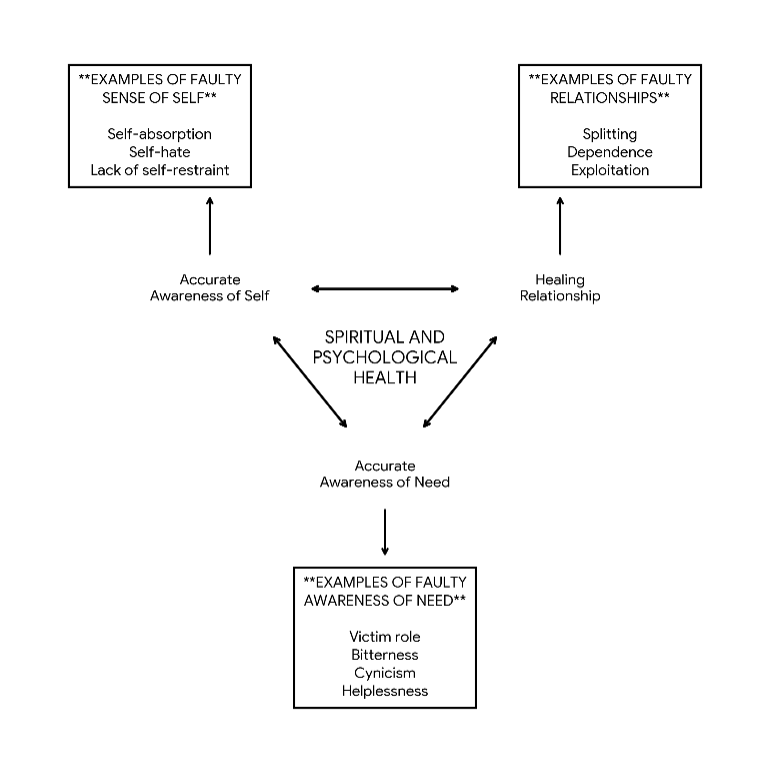
Figure 2. An interactive map of psychological and spiritual health. (Adapted from Mark R. McMinn, Psychology, Theology, and Spirituality in Christian Counseling [Wheaton, IL: Tyndale House Publishers, 1996], 32.)
McMinn also argues that it is a false choice between theology and psychology. Anxiety may involve spiritual struggles, distorted thinking patterns, relational wounds, and biological factors simultaneously. Effective care then requires contributions from theology and psychology.
Siang-Yang Tan, in his book Counseling and Psychotherapy: A Christian Perspective, also argues for integrating clinical care and spiritual formation. He believes that Christian counseling should remain clinically competent while remaining theologically faithful. In chapter 14, he lays out a few of the major approaches to integrating theology and psychology. His approach is that Christianity should integrate psychology. He believes that to develop a distinctly Christian psychology, one must ground it in biblical and historical theology. He believes that Scripture is primary for a Christ-centered approach to counseling. “Thus Scripture has ultimate authority because it is the inspired Word of God that does deal with the major issues and problems of human beings, especially when properly interpreted in thematic and extended application contexts.”6
His basic view of humanity from a biblical perspective informs his views on a biblical model of Christian counseling.
1. Basic psychological and spiritual needs include needs for security (love), significance (meaning/impact), and hope (forgiveness).
2. Basic problem is sin—but not all emotional suffering is due to personal sin.
3. Ultimate goal of humanity is to know God and have spiritual health.
4. Problem feelings are usually due to problem behavior and, more fundamentally, problem thinking—however, biological and demonic factors should also be considered.
5. Holistic view of persons—all have physical, mental/emotional, social, and spiritual dimensions.
Tan’s views are consistent with this belief that counseling must address emotional, relational, and spiritual dimensions simultaneously. To do this, he believes in integrating implicit and explicit approaches into the clinical practice of Christian therapy. “The Christian therapist using an implicit integration approach will still be silently praying for the client and be authentic in showing agape love to the client. The Christian therapist thus will reflect biblical values and convictions without imposing them on the client or explicitly discussing such religious issues in a verbal way with the client.”7 Explicit integration includes the use of spiritual resources, such as prayer, Scripture, and referrals to religious groups, addressing spiritual issues during a therapy session, and fostering the development of spiritual formation practices in the therapist and client.
Tan especially values the use of these explicit practices in the treatment of anxiety and worry. He views anxiety as a multidimensional issue requiring holistic care. Spiritual practices such as prayer and meditation on Scripture can support healing, but they are not a replacement for clinical treatment when more serious symptoms are present.
Curt Thompson’s book, Anatomy of the Soul, is a resourceful look at how both spiritual and neurological realities shape human experience. He uses the language of neuroscience and attachment to explore how we understand and experience our lives with God. He explores being known, attention, memory and emotion, attachment, the integrated mind, sin and redemption, and community.
Thompson explores the significant role relationships play in mental and emotional health. He writes about how habits, attachment, community, and spiritual practices influence the brain. He also explores how spiritual formation affects both the soul and the brain.
Thompson’s work suggests that anxiety cannot be fully understood apart from biological and relational factors. Trauma, attachment wounds, and neurological processes can contribute significantly to an individual’s experience of anxiety. Chapter six lays out how emotions are not just biological events but also a part of a person’s relationship with God. He also notes about emotion, “1. Emotion is something that you regulate and that regulates you. 2. Emotional states are not influenced or created in isolation. 3. Emotion is not debatable. 4. While categorical emotions are universal across time, cultures, and gender, primary emotion does not always present itself in the same way.”8
Each of these authors approaches anxiety from different perspectives. But several common themes emerge. All reject reducing anxiety to a single cause. Each recognizes that human beings are complex creatures whose experiences involve spiritual, emotional, relational, cognitive, and physical dimensions. McMinn highlights the need for dialogue between theology and psychology. Tan focuses on counseling practices, and Thompson explores neuroscience and attachment. Together, these authors provide a framework for understanding anxiety as a whole-person experience.
Comparative Analysis
Let us put this all together now. We have seen that psychology and theology share similar approaches and beliefs about anxiety, but they are not perfectly aligned. We will examine four areas of agreement and four of disagreement before moving on to an integrated pastoral theology of anxiety.
Four Areas of Agreement
First, both theology and psychology recognize a difference between normal and dysfunctional anxiety. As we saw in Paul’s reference to Timothy in Philippians 2, concern is commendable. But as we also saw in the Scriptures, anxiety that displaces our trust in God is problematic. The writings above also showed that the clinical world recognizes that nonpathological anxiety exists. But they also understand that pathological anxiety is excessive and impairing.
Second, each recognizes human vulnerability. Scripture is abundantly clear from Genesis 3 until Revelation 21 that human beings are vulnerable to sickness, corruption, and death in the body, heart, and mind. Corruption in the mind leads to incorrect thinking, including worry, which often emerges from uncertainty. Psychology observes that anxiety also develops around uncertainty and perceived threats. Each might have a different explanation, but they both observe human vulnerabilities.
Third, both recognize that anxiety requires a response. Scripture and theology will turn towards prayer and a deeper trust or dependence on God. Psychology promotes counseling, cognitive restructuring, or behavioral interventions. Though they have different responses, neither view recommends passive acceptance.
Fourth, each recognizes that anxiety impacts the whole person. Theology discusses how anxiety impacts all areas of our heart, mind, and body. Psychology understands that anxiety affects our thinking, emotions, behaviors, and relationships. While each might focus on a slightly different emphasis, neither sees anxiety as just limited to the mind.
Four Areas of Disagreement
Despite areas of agreement, there are important differences. First, theology and psychology disagree on the fundamental cause of anxiety. Psychology focuses on biology, trauma, cognition, and environment. Scripture will focus on trust, dependence, and humanity’s sinful nature. While these may not necessarily seem contradictory, each offers a different level of explanation. Psychology focuses on biological and cognitive issues. Scripture identifies spiritual explanations.
Second, they both disagree on the nature of the problem. Psychologists will identify dysfunction, distress, and impairment as the core nature of the problem. Theology will identify spiritual and relational concerns. The differences here are around symptoms and sin.
Third, each has a different goal for healing. Psychology wants to achieve symptom reduction and improved functioning. Scripture wants to foster a deeper trust in God, peace, and faithfulness.
Fourth, each has a different source for healing. Psychology exclusively utilizes therapeutic intervention. Theology will utilize prayer, community, worship, and Scripture. Psychology relies on the DSM-5-TR, and theology relies on the Bible.
While biblical and psychological perspectives approach anxiety from different starting points, they are not necessarily competing explanations. Psychology offers insights into the mechanisms through which anxiety develops and affects human functioning. Scripture addresses the meaning, purpose, and spiritual dimensions of anxiety. Together, they provide a more complete picture than either perspective could offer on its own.
Toward an Integrated Pastoral Theology of Anxiety
What has been demonstrated in the preceding sections is that neither biblical theology nor contemporary psychology alone can provide a complete account of anxiety. Scripture speaks to the realities of trust, dependence, prayer, and God’s provision, while psychology provides insights into the emotional, cognitive, physiological, and relational dimensions of anxiety. An integrated pastoral theology must take both perspectives seriously to provide faithful and effective care for individuals struggling with anxiety.
Anxiety as a Whole-Person Experience
Human beings are not simply minds. Nor are they merely bodies. And they are not only spirits. Human beings, created in the image of God, are hearts, minds, bodies, and souls. These parts of our humanity are not disconnected pieces that make a whole. They all play off one another, interacting and triggering reactions within us. And anxiety should be understood as a whole-person experience affecting hearts, minds, bodies, emotions, relationships, and spiritual lives.
Our bodies, the physical dimension of being human, are affected by anxiety. It heightens our nervous system. It can make getting out of bed difficult. It affects our hormones. Our genetics influences it. And it can affect our brain functioning.
Our brains, the mind, or cognitive dimension of being human, are also affected by anxiety. Worry and anticipation creep into our thinking. Left unchecked, it can turn into catastrophic thinking. Our worry causes us to rehearse outcomes for every situation we find ourselves in.
Our emotions, the heart dimension of being human, can experience fear because of anxiety. This will lead to distress. And finally, it is capped off by uncertainty.
Human beings were created to live in community with one another. But anxiety affects our relationships. People with anxiety will develop attachment challenges. They may experience loneliness and struggle to fit into community groups.
Finally, human beings have a spiritual dimension. Anxiety will cause us to lose some trust in God. It may draw us away from prayer and cause us to lose dependence on God. And it will affect our worship of God.
Anxiety as both suffering and spiritual concern
Many Christians treat anxiety as a sin. This is unhelpful and can push people away from faith communities. Secular approaches will treat anxiety as only a symptom. This can be dismissive or reductionist. A more complete view would be to understand that anxiety involves both suffering and spiritual concerns simultaneously.
Anxiety can bring about suffering in our mind and body. This can be caused by trauma or grief. Anxiety can also cause chronic stress or physical illness. Anxiety also has spiritual concerns, including distrust, self-reliance, or misplaced security. Not all anxiety arises from personal sin, yet anxiety often raises spiritual questions about trust, identity, dependence, and hope.
Philippians 4 Revisited
What does obedience to God’s Word in Philippians 4 look like? Paul tells the people of Philippi not to be anxious about anything. But he does not merely forbid anxiety. He directs the people to prayer, supplication, and thanksgiving. And he promises peace.
The life of the believer, while marked by the transformative power of the Holy Spirit, is not an instant transformation into a perfect human being. Instead, the process of being formed into the image of Jesus Christ is a lifelong process. It is not a journey marked by continuous progression. The process of healing and being transformed by the Holy Spirit is not linear.
Philippians 4:6-7 should not be interpreted as a demand to eliminate all anxious feelings immediately. Rather, Paul presents a distinctly Christian response to anxiety by directing believers toward prayerful dependence upon God. Believers continually return to dependence upon God throughout their entire lives. Sanctification is ongoing and imperfect, yet God continually calls believers back to Himself.
Obedience to Philippians 4 is not primarily the immediate elimination of anxious feelings. It is the continual practice of bringing anxiety before God in prayer, thanksgiving, and dependence. And when we are doing that, God gives us His peace.
Implications for Pastoral Care
Pastoral ministry to those with anxiety begins with a proper teaching on biblical trust. This includes helping people understand what prayer is and what dependence on God looks like. And it teaches people what thanksgiving to God truly is. And it points to the hope that we have in Jesus Christ, his defeat of sin, death, and the devil, and the resurrection to new life that all believers will experience one day.
Pastors and church workers also must avoid the tendency toward oversimplification. “Just trust God,” or “You only need therapy,” or “Just have more faith” are all reductionist statements. Pastors may oversimplify because they may not feel qualified. Pastors need to practice what they preach and trust God to provide the right words for them. This may look like attending a conference or picking up a book to learn more about mental health and the human brain.
Pastoral care must also understand that there are clinical realities to anxiety. Anxiety orders exist. Trauma exists. Biological factors exist. Not every anxious person is experiencing a discipleship problem. Prayer can be a part of the healing process, but it cannot be the only part for those who experience generalized anxiety disorders.
Churches must be places of community. They can create spaces for relationships to grow. The worship space and the congregation can help people feel like they belong. Prayers should not just be lip service to generic health concerns. Pray directly for those experiencing anxiety. And offer support.
But that support should not be limited to pastoral counseling. Pastors are not therapists or psychiatrists. They need to refer, refer, refer. Pastors must recognize when to involve counselors, therapists, psychologists, physicians, and psychiatrists. All God to work through trusted professionals to provide care for people experiencing anxiety.
Proposed Integrated Model
Four forms of care could all be integrated to provide balanced pastoral care for the individual experiencing anxiety. These are spiritual, emotional, relational, and clinical care.
Spiritual care includes developing skills and rhythms for a life of prayer. This will help the person maintain a closeness to God, even when anxiety isolates. There should also be a rhythm of time in Scripture. This will also help a person maintain a closeness to God. Finally, there needs to be a rhythm of worship. This can help the person see their dependence on God.
Emotional care includes healthy emotional awareness. There can also be grief work. And finally, there needs to be emotional support.
Relational care includes creating safe communities. These need to be places where people can experience the positive effects of being part of the family of God. Pastors can also provide mentoring and discipleship.
Clinical care includes referrals to proper counseling centers or resources. It may also need to include encouragement for seeking medical treatment when appropriate. And it also needs to have positive words in sermons, prayers, Bible studies, or any other time the church worker is with a church member, about doctors, therapists, medicine, and clinical care.
Effective pastoral care recognizes that anxiety rarely exists within a single domain. A faithful response attends to the whole person rather than reducing anxiety to a spiritual or psychological problem.
Anxiety is best understood as a whole-person experience involving spiritual, emotional, cognitive, relational, and psychological dimensions. Scripture offers indispensable guidance concerning trust, prayer, and dependence upon God. Psychology provides valuable insight into the mechanisms through which anxiety develops and affects human functioning. And integrated pastoral theology therefore seeks neither to replace psychological care with spiritual practices nor to replace spiritual care with therapeutic techniques. Instead, it recognizes that faithful care attends to the entire person created and redeemed by God.
Conclusion
This paper sought to answer the question: how do biblical and psychological understandings of anxiety complement and challenge one another in the care of individuals with anxiety? Through an examination of Philippians 4:6-7, Jesus’ teachings on worry, contemporary psychological definitions of anxiety, and several contemporary Christian approaches to counseling and mental health care, it has become clear that anxiety cannot be reduced to a single cause or explanation. Both Scripture and psychology recognize that anxiety is a real aspect of human experience and that it requires an intentional response.
Scripture frames anxiety primarily through the themes of trust, dependence upon God, prayer, and divine provision. Contemporary psychology approaches anxiety through emotional, cognitive, psychological, and behavioral frameworks. While these perspectives differ in emphasis and methodology, they are not necessarily contradictory. Rather, they often address dimensions of the same human experience. Scripture helps explain the spiritual significance of anxiety and directs believers toward God. At the same time, psychology offers valuable insight into the factors that contribute to anxiety and the ways it affects human functioning.
Anxiety is best understood as a whole-human experience involving spiritual, emotional, cognitive, relational, and physical dimensions. Therefore, faithful pastoral care should neither reduce anxiety to a purely spiritual problem nor a purely clinical problem. Instead, pastors should seek to integrate biblical wisdom concerning trust in God with appropriate psychological insight. Obedience to Philippians 4 is not primarily the immediate elimination of anxious feelings. It is the continual practice of bringing anxiety before God in prayer, thanksgiving, and dependence. As believers continually return to God, they receive the promise of His peace, which guards hearts and minds through Christ Jesus.
BIBLIOGRAPHY
The Holy Bible: English Standard Version. Wheaton, IL: Crossway Bibles, 2025.
American Psychiatric Association. Diagnostic and Statistical Manual of Mental Disorders: DSM-5-TR. Washington, United States: American Psychiatric Association Publishing, 2022.
Danker, Frederick W. and Walter Bauer. A Greek-English Lexicon of the New Testament and Other Early Christian Literature. 3rd ed. Chicago, IL: The University of Chicago Press, 2000.
Engelbrecht, Edward, and Paul E. Deterding. The Lutheran Study Bible: English Standard Version, Concordia Pub. House, 2009.
Fee, Gordon D. Paul’s Letter to the Philippians. 1st ed. Grand Rapids: Wm. B. Eerdmans Publishing Co., 1995.
Gibbs, Jeffrey A. Matthew 1:1-11:1. St. Louis, MO: Concordia Publishing House, 2006.
McMinn, Mark R., Gary R. Collins, and American Association of Christian Counselors. Psychology, Theology, and Spirituality in Christian Counseling. Carol Stream, Illinois: Tyndale House Publishers, Inc, 2011.
Strong, James. The New Strong’s Dictionary of Hebrew and Greek Words. Nashville, TN: Thomas Nelson, 1996.
Tan, Siang-Yang. Counseling and Psychotherapy: A Christian Perspective. 2nd ed. Grand Rapids: Baker Academic, 2011.
Thompson, Curt. Anatomy of the Soul: Surprising Connections between Neuroscience and Spiritual Practices that can Transform Your Life and Relationships. 1st ed. Published/Created Carol Stream, Illinois: SaltRiver, 2010.
Photo by Annie Spratt on Unsplash
- Gordon D. Fee, Paul’s Letter to the Philippians, 1st ed. (Grand Rapids: Wm. B. Eerdmans Publishing Co, 1995), 333. ↩︎
- Ibid. ↩︎
- Engelbrecht and Deterding, The Lutheran Study Bible: English Standard Version, 2019 ↩︎
- Jeffrey A. Gibbs, Matthew 1:1-11:1 (St. Louis, MO: Concordia Publishing House, 2006), 365. ↩︎
- Psychiatric Association American, Diagnostic and Statistical Manual of Mental Disorders: DSM-5-TR (Washington, DC: American Psychiatric Association Publishing, 2022), 251. ↩︎
- Siang-Yang Tan, Counseling and Psychotherapy: A Christian Perspective, 2nd ed. (Grand Rapids: Baker Academic, 2011)., chap. 14 ↩︎
- Ibid., 15. ↩︎
- Curt Thompson, Anatomy of the Soul: Surprising Connections between Neuroscience and Spiritual Practices that can Transform Your Life and Relationships, 1st ed. (Published/Created Carol Stream, Illinois: SaltRiver, 2010)., chap. 1 ↩︎


Leave a Reply